-
Featured News
Don’t Forget Me – Eddie Cochran documentary set for 2026
 By Harvey Kubernik
Eddie Cochran, guitarist, singer, and songwriter was a pioneering rock and roll icon who left an indelible mark on countless musicians. Dying and just age 21 in 1960, h
By Harvey Kubernik
Eddie Cochran, guitarist, singer, and songwriter was a pioneering rock and roll icon who left an indelible mark on countless musicians. Dying and just age 21 in 1960, h -
Featured Articles
Donovan's Sunshine Superman at 60
 By Harvey Kubernik
Sunshine Superman is the third studio LP by singer-songwriter Donovan. On August 26, 1966, it was released in the United States on Epic Records.
Donovan and his recor
By Harvey Kubernik
Sunshine Superman is the third studio LP by singer-songwriter Donovan. On August 26, 1966, it was released in the United States on Epic Records.
Donovan and his recor -
Death Trip: Iggy and the Stooges 1972-74 by Michael S. Begnal (Reaktion Books)
Review by Duncan Fallowell
The Ancient Greeks invented beat music when Crotus, satyr of Mount Helicon, clapped his hands in time to the singing of the Muses. Beat is hypnotic and soon became essential to the public Dionysiac rites in which music, dance, intoxication, and all forms of sexual activity liberated participants from the quotidian. Christianity stamped out the Dionysiac; and it didn’t return in either the Renaissance or the Enlightenment. But it did in my lifetime, in the Rock Revolution that began with the Beatles and reached a climax in the late 1960s and early 70s.
In order to do this, the pop song had to be extended in time. Jazz and funk were too polite.
Progressive rock was composed-through and too fixed. Enter Andy Warhol, the greatest taboo-breaker of the twentieth century. He told his band the Velvet Underground to create extended rivers of throbbing music in live happenings. Long-groove/wall of sound was born. But the Velvets left Warhol’s orbit and went twee.
So where could we Dionysiacs go after this? There were two options. Firstly Can from Cologne, who had come out of the electronic avant garde, discovered beat, and were the first to make long-groove/wall of sound their staple vehicle on LPs – with astounding results. Secondly the Stooges from Detroit. Their second album Fun House (1970) was extreme, not only in the stripped-down roar of the band but also in the lyrics and behaviour of their front man Iggy who lacerated himself in performance. But was it long-groove? In part, yes; and that was clearly their direction.
Then the Stooges disappeared.
Suddenly a London concert was announced: July 15th 1972, the King’s Cross Cinema. It began at midnight. Some concerts transcend their programme to become cultural markers.
Beethoven, December 22nd 1808, Vienna. Judy Garland, April 23rd 1961, Carnegie Hall. And I would add this one. In 1972 theatre-in-the-round, audience participation, performance art were highly current, but they’d never been married to the Dionysiac. In the UK we had a Dionysiac performance artist in Stuart Brisley who put on hair-raising events, cutting up live chickens, throwing blood around. But Stuart didn’t have a band. Iggy certainly did; and on that unforgettable night he became Crotus the Satyr, stripped but not seductive, very confrontational, very strange, his voice ranging from sweet to howl. He repeatedly and violently rushing into the auditorium, prowling, predatory. And he was backed by the most pitiless long-groove/wall of sound I’ve ever heard. The audience was terrified. Finally the band dumped their guitars on the speakers and left the stage, to feedback whines and gurgles. We stumbled into the night bewildered, euphoric. It was the Stooges only appearance outside America. True to performance art, it was not a show, not a repeatable act. It was a one-off and became a legend. That concert is why this book is being published.
Its author was born in 1966, so he wasn’t there. An obsession comes from a desire to reach the unattainable. Much scholarship is driven by this and Begnal is scholarly. Since he can’t experience the Stooges directly he zooms in on the album that followed the London concert, Raw Power, with a forensic examination of how each track came into being. Every reference is immaculately noted. His commitment revs up to an amphetamine squeal.
Begnal’s analysis is a labour of love; and in its way an extraordinary act of performance in itself. However I do feel that it is based on an underlying misjudgement, namely that Raw Power represents the Stooges career high-point simply because it is the first Punk album. Maybe it is the first Punk album. Others have said so. But Punk, for all its seering verve, was a return to snappy little numbers. Begnal’s book duly demonstrates Raw Power’s ancestry in the trad rock catalogue of short songs.
What had happened to the Dionysiac, the long-groove, the unique and special in the Stooges? David Bowie had come into Iggy’s life. Bowie, the genius of rock lieder – and of packaging. Bowie produced Raw Power and packaged Iggy. Perhaps he also gave the album its naff title. When Raw Power was released I remember feeling let down. I gave it a positive review (which Begnal quotes) but more in loyalty and hope than conviction. The promise of Fun House, of King’s Cross, had not been realised.
Dionysiac outburst flared briefly in the Sex Pistols later, then died. As for the book’s title Death Trip – Iggy is still living, comfortably, near Miami. And what of long groove/wall of sound? With the arrival of the 12-inch single, it merged with Disco, Funk and computer electronics, leading to Dance, Trance, Techno, Rave, Drone, and when all that turned into mere knob-twiddling clichés, it slipped over to the classical world where it had always had a sibling, from Corelli to Morton Feldman, and became a fruitful new form among the conservatoire set. You may sometimes hear it, not always shorn of its elemental terrors and drive, on BBC Radio 3’s wonderful New Music Show.
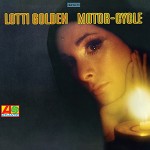
Lotti Golden’s Motor-Cycle Reissued by High Moon Records
By Harvey Kubernik
I remember in late 1969 when an acquaintance of mine, Heather Harris, an editor at the UCLA Daily Bruin Entertainment pages, received a copy of the Bob Crewe-produced Lotti Golden debut LP Motor-Cycle on Atlantic Records.
Harris, and another concert pal of mine, Nancy Rose Retchin at Palisades High School, were big fans of Laura Nyro, and both knew I liked female singers and poets.
In winter of 1969 I first heard Golden’s Motor-Cycle on KPPC-FM in Pasadena, California, and got my own copy of the album at Wallichs Music City in Hollywood. I had read reviews of her in Newsweek and The New York Times when I stocked shelves in the library at West Los Angeles Junior College in Culver City.
Golden’s stream of consciousness lyrics was influenced by the beat generation and Jack Kerouac. Motor-Cycle wasn’t Brill Building pop music, but songs about narcotics, gender identity, the ramifications of involvement, and urban alienation from a Thrill Building tunesmith who was the landlord doing the reporting.
In 1968 and ’69, Heather, Nancy and I went monthly to the Shrine Exposition Hall in downtown Los Angeles for the Pinnacle Dance Concerts. Three former USC students, Sepp Donahower, Mark Chase and John Van Hamersveld, promoted 13 shows of visiting acts and local bands. It was where art, film and music collided. Filmmaker George Lucas was on the Single Wing Turquoise Bird lightshow crew. We saw Moby Grape, Canned Heat, Buffalo Springfield, Jefferson Airplane, Vanilla Fudge, Pogo (pre-Poco), Lee Michaels, Mothers of Invention, Richie Havens, and Sweetwater.
BIRTHDAY BAMA LAMA: A Calendar of 365 Musical Mugshots by Olaf Jens

By Mike Stax
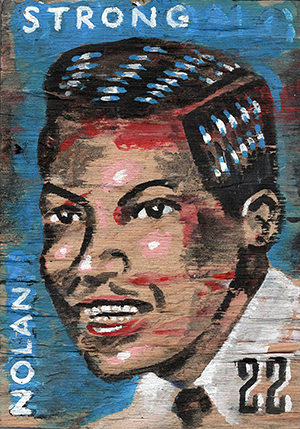
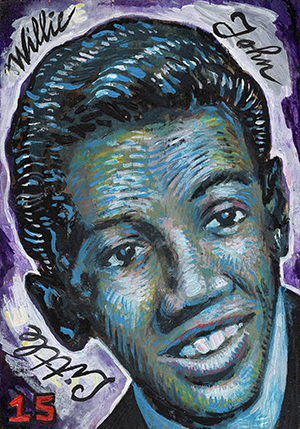
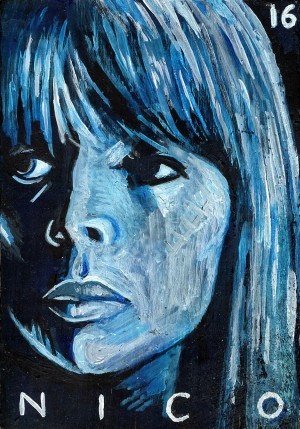
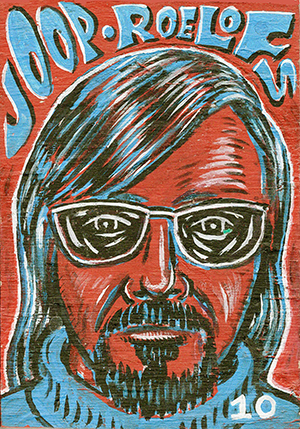
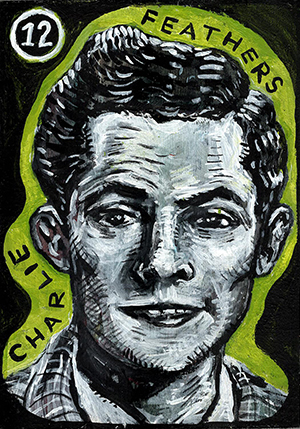
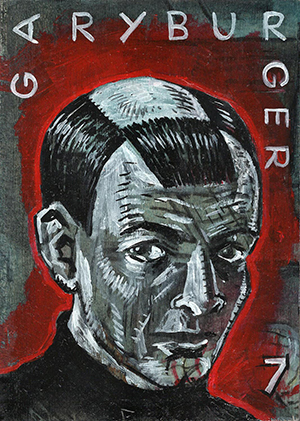
Dutch-born California resident Olaf Jens is one of my favorite living artists. Inspired by great comic book illustrators like Will Eisner and Robert Crumb and the New Objectivity artists of the 1920s like Otto Dix and Max Beckmann, his work is executed with skill, imagination and an all-too-rare flair for character and atmosphere. His artwork can be seen on an array of record covers released over the past decade or so including the Twisted Tales from the Vinyl Wasteland series, Back from the Grave Volumes 9 and 10, and releases by the Jackets, the Chrome Cranks, the Kentucky Colonels, the Legendary Stardust Cowboy, and more. He’s also responsible for the fabulous banner for our “Echoes from the Vault” reviews section in Ugly Things.
Olaf’s character portraits of his favorite musicians from the world of rock ‘n’ roll, R&B, punk, garage, country music and more are especially well-rendered. He recently produced an eye-popping calendar with an incredible 365 color illustrations, each assigned to their date of birth—from country singer Ernie Chaffin on January 1 through Egyptian vocalist/actress Oum Kalthoun on December 31.
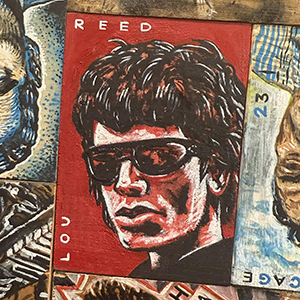
Famous names like Dolly Parton, Little Richard, Gene Vincent, Don Everly, Tina Turner, Bo Diddley, Lou Reed, Roy Oribson and Iggy Pop, are featured alongside lesser-known cult figures like Cathy Berberian, Adrian Lloyd and Robert Drasnin. There’s ‘60s garage icons like Sky Saxon, Gerry Roslie, Question Mark, Moulty, and Sam the Sham; UK ‘60s heroes like Syd Barrett, Chris Britton, Dave Davies, Screaming Lord Sutch, and Sharon Tandy; blues and R&B artists like Jimmy Reed, Elmore James, Slim Harpo, Ruth Brown, Nathaniel Mayer, Howlin’ Wolf, and Charlie Patton; rockabilly cats Johnny Burnette, Gene Summers, The Phantom, Charlie Feathers, and Cliff Gallup; country singers like Loretta Lynn, Porter Wagoner, and Red Sovine; legendary producers like Sam Phillips, Joe Meek, and Sir Coxsone Dodd; a plethora of punk rock and post-punk characters including Jean-Jacques Burnel, Mark E Smith, Rat Scabies, Joey Ramone, Poly Styrene, Richard Hell, Lux Interior, Ed Kuepper, and Johnny Strike; neo-garage rock mavericks like Billy Childish, Russell Quan, Holly Golightly, Jon Spencer, Johnny Bartlett, King Khan, Fink, and Monoman; and outliers like Sun Ra, Eric Satie, Harry Smith, Chopin, Nico, Jack Kerouac, Korla Pandit, Criswell, Brigitte Bardot, Omar Korshid, and Anton LaVey. Scattered among them all are a host of upper echelon Ugly Things heroes including Phil May, Viv Prince, Wally Tax, Joop Roelofs, Arthur Lee, Cyril Jordan, Gary Burger, and Gabor Szabo.

Each portrait was painted with acrylic on 3.5” x 5” wooden panels, most of which were quickly snapped up by collectors and fans. But if you want every last one of them, you can hang this beautifully-presented collection of 365 on your wall instead.
For more details, email olaf.jens@g
mail.com