-
Featured News
Don’t Forget Me – Eddie Cochran documentary set for 2026
 By Harvey Kubernik
Eddie Cochran, guitarist, singer, and songwriter was a pioneering rock and roll icon who left an indelible mark on countless musicians. Dying and just age 21 in 1960, h
By Harvey Kubernik
Eddie Cochran, guitarist, singer, and songwriter was a pioneering rock and roll icon who left an indelible mark on countless musicians. Dying and just age 21 in 1960, h -
Featured Articles
Donovan's Sunshine Superman at 60
 By Harvey Kubernik
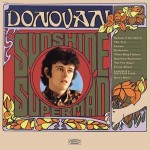
Sunshine Superman is the third studio LP by singer-songwriter Donovan. On August 26, 1966, it was released in the United States on Epic Records.
Donovan and his recor
By Harvey Kubernik
Sunshine Superman is the third studio LP by singer-songwriter Donovan. On August 26, 1966, it was released in the United States on Epic Records.
Donovan and his recor -
BIRTHDAY BAMA LAMA: A Calendar of 365 Musical Mugshots by Olaf Jens

By Mike Stax
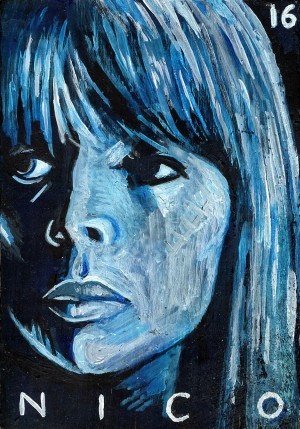
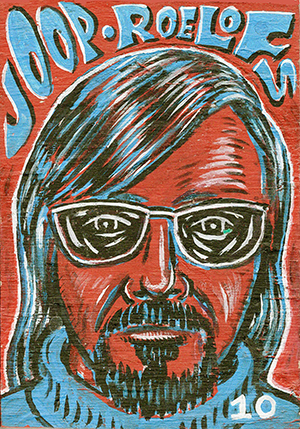
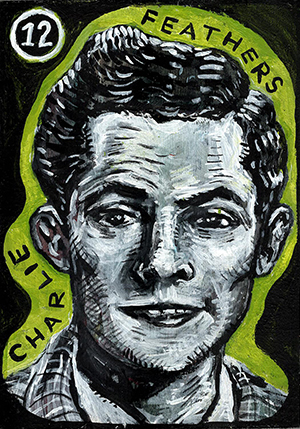
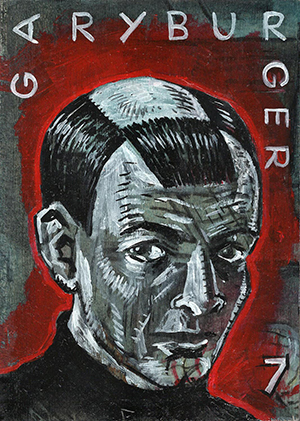
Dutch-born California resident Olaf Jens is one of my favorite living artists. Inspired by great comic book illustrators like Will Eisner and Robert Crumb and the New Objectivity artists of the 1920s like Otto Dix and Max Beckmann, his work is executed with skill, imagination and an all-too-rare flair for character and atmosphere. His artwork can be seen on an array of record covers released over the past decade or so including the Twisted Tales from the Vinyl Wasteland series, Back from the Grave Volumes 9 and 10, and releases by the Jackets, the Chrome Cranks, the Kentucky Colonels, the Legendary Stardust Cowboy, and more. He’s also responsible for the fabulous banner for our “Echoes from the Vault” reviews section in Ugly Things.
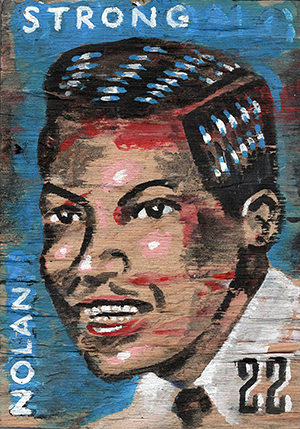
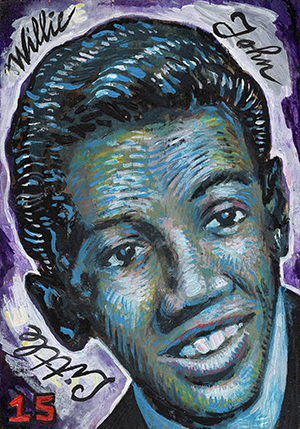
Olaf’s character portraits of his favorite musicians from the world of rock ‘n’ roll, R&B, punk, garage, country music and more are especially well-rendered. He recently produced an eye-popping calendar with an incredible 365 color illustrations, each assigned to their date of birth—from country singer Ernie Chaffin on January 1 through Egyptian vocalist/actress Oum Kalthoun on December 31.
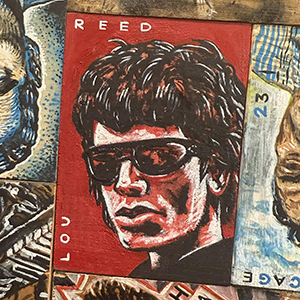
Famous names like Dolly Parton, Little Richard, Gene Vincent, Don Everly, Tina Turner, Bo Diddley, Lou Reed, Roy Oribson and Iggy Pop, are featured alongside lesser-known cult figures like Cathy Berberian, Adrian Lloyd and Robert Drasnin. There’s ‘60s garage icons like Sky Saxon, Gerry Roslie, Question Mark, Moulty, and Sam the Sham; UK ‘60s heroes like Syd Barrett, Chris Britton, Dave Davies, Screaming Lord Sutch, and Sharon Tandy; blues and R&B artists like Jimmy Reed, Elmore James, Slim Harpo, Ruth Brown, Nathaniel Mayer, Howlin’ Wolf, and Charlie Patton; rockabilly cats Johnny Burnette, Gene Summers, The Phantom, Charlie Feathers, and Cliff Gallup; country singers like Loretta Lynn, Porter Wagoner, and Red Sovine; legendary producers like Sam Phillips, Joe Meek, and Sir Coxsone Dodd; a plethora of punk rock and post-punk characters including Jean-Jacques Burnel, Mark E Smith, Rat Scabies, Joey Ramone, Poly Styrene, Richard Hell, Lux Interior, Ed Kuepper, and Johnny Strike; neo-garage rock mavericks like Billy Childish, Russell Quan, Holly Golightly, Jon Spencer, Johnny Bartlett, King Khan, Fink, and Monoman; and outliers like Sun Ra, Eric Satie, Harry Smith, Chopin, Nico, Jack Kerouac, Korla Pandit, Criswell, Brigitte Bardot, Omar Korshid, and Anton LaVey. Scattered among them all are a host of upper echelon Ugly Things heroes including Phil May, Viv Prince, Wally Tax, Joop Roelofs, Arthur Lee, Cyril Jordan, Gary Burger, and Gabor Szabo.

Each portrait was painted with acrylic on 3.5” x 5” wooden panels, most of which were quickly snapped up by collectors and fans. But if you want every last one of them, you can hang this beautifully-presented collection of 365 on your wall instead.
For more details, email olaf.jens@g
mail.com

FLOWERS IN THE RAIN: THE UNTOLD STORY OF THE MOVE by Jim McCarthy
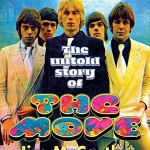
(Wymer, 2024, 403 pages)
Review by Alan Clayson
Because I found Jim such a nice bloke during correlated e-mail correspondence, I don’t want to give his diligently-researched work a rubbishing. Yet it has to be said that, perhaps through ham-fisted sub-editing, sentences are often split up. Like this. Which may prove irritating. So might factual and syntactic repetition, and, in the process of scene-setting, going off on not entirely relevant tangents. Moreover, the lack of an index may frustrate anyone seeking raw information. In this regard, a few minor errors might not matter. For example, while it’s correct that the use of Tchaikovsky’s “1812” riff in “Night Of Fear,” the maiden A-side that kicked off the Move’s five-year run of domestic hits, was pre-empted by Ike and Tina Turner in their “Tell Here I’m Not Home” opus, this came out in 1964—not 1966. Also, it’s Johnnie Ray not Johnny Ray, and what’s this about ‘Clifford Bennett and The Rebel Rousers’?
The reader is left too with unanswered questions. Why, say, was Roy Wood expelled from Moseley College of Art? Was Tamla Motown’s cosseted Little Stevie Wonder really among four mere support acts to the Move at Birmingham’s Club Cedar on February 3, 1966? What was the genealogical connection between Unit 4 + 2 and Tomorrow figured out by an author given to mixed metaphors—e.g. “the weak link in the chain is the one who becomes the sacrificial lamb”—and opinionated digs at the respective likes of Ginger Baker (“a clodhopper of a drummer”) and Syd’s Pink Floyd (“half-assed playing, sloppy drumming, allied to pretentious lyrics. Middle-class student music”)?
Yet, if nothing else, this offering is more than simply thorough—as demonstrated by both 1967’s “Wave The Flag And Stop The Train” flip-side featuring “a wonderful, harmonized confusion of vocals between 1:39 and 1:50 seconds,” and maybe too much detail about a particularly sick-making jape in the van between gigs. Crucially, the account is carried by McCarthy’s infectious enthusiasm that, if over-effusive sometimes, tells an intriguing tale rooted in grassroots struggles of the West Midlands beat groups from whence would spring in 1966 the ‘classic’ line-up of the Move, i.e. singer Carl Wayne with guitarists Roy Wood and Trevor Burton, drummer Bev Bevan and Chris ‘Ace’ Kefford on bass—who all took lead vocals at designated points during a stage presentation involving fireworks, smoke bombs, lighter fluid and Wayne charging about with an axe to implode televisions and hack at effigies of political personages like Prime Minister Harold Wilson who, after being caricatured in a rude postcard circulated to publicize 1967’s “Flowers In The Rain” single , won a libel suit against the quintet and their manager, Tony Secunda (“almost ‘situationist’ in his preferred style of creating chaos,” writes McCarthy).
Before the year was out too, the discords and intrigues that make pop outfits what they are had started to overwhelm the Move. First to go was Ace Kefford, given pride of place on the book’s front cover, having been singled out loudly by a prominent London promoter as the combo’s chief visual selling point—with all the concomitant resentment—for his Norse god androgyny with underlying dread. He was also a composer whose efforts were marginalized by Wood’s near-monopoly of originals. Indeed, Kefford was responsible for “William Chalker’s Time Machine,” the best-remembered 45 by the Lemon Tree—which had it been attributed to the Move, would have been a sure-fire smash.
Effectively, Ace sacked himself after starting to go the same brain-frazzled way as Syd Barrett when the Move and Pink Floyd were each on a round-Britain package tour with the Jimi Hendrix Experience and Amen Corner, that, in less absolute fashion, was on a par with that fated “scream circuit” trek in 1960 co-headlined by Gene Vincent and Eddie Cochran.
Kefford’s creation of “a hole that was never filled” did not, however, impede the Move’s onwards-and-upwards trajectory as they scored a Number One with “Blackberry Way,” although during its Top of the Pops plugs, Burton’s constant scowl and Brooding Intensity became less an effusion of ‘image’ than the real thing. Irked by Wood’s increasing control of the ensemble’s destiny, he was soon to depart—as would Wayne, but not before the latter had advocated the Move’s unhappy stab at cabaret on the same bills as corny variety acts.
Bevan and Wood rallied by enlisting Jeff Lynne, X-factor of the picked-to-click Idle Race, but, garbed and painted like a psychedelic Wild Man Of Borneo, Wood was at the central microphone for “Brontosaurus” and remaining British chart entries during the three’s plotting of the Electric Light Orchestra and the late Carl’s discarded but “very cool and practical idea” of fronting a Move with Ace and Trevor back in the fold.
Flowers In The Rain also addresses the post-Move careers of all concerned, and a discography plus lists of electric media appearances and even the venues for cancelled tours in the USA (where the group surfaced only as cult celebrities) are included in the appendices of a history that, while it won’t win Jim a Nobel Prize for Literature, will serve as both a useful starting point for Move beginners and a necessary purchase for long-time devotees.
OISTER – 1973-74 (Hozac) 2-LP
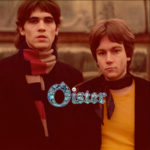
Heaven-sent for fans of classic ‘70s pop, this is the first ever release by the legendary Tulsa outfit comprising Dwight Twilley and Phil Seymour who would soon thereafter become the great Dwight Twilley band. The Twilley band were a unique hybrid of harmonic Anglophile pop/rock and rockabilly who released two brilliant albums on Shelter—one very polished, one much earthier—before the two principals went solo. Oister was the same but different. The differences may come down to recording technique or simply the youth of our heroes.
There is a charming fragility and innocence here not found in the later Twilley or Seymour stuff. And a dreaminess: indeed much of this is the embodiment of the term ‘dream pop’ and should appeal to a whole host of people who find the concept of power pop anathema. And the current crop of Big Star fans. The lo-fi aspect will also appeal to fans of DIY. There’s a little bit of the baroque but for the most part it’s spirited, minimalist early Beatles/Hollies-style pop rock, with a rootsiness learned from early mentor and former Sun artist Ray Harris, and the frequent prominence of Twilley’s piano lets you know it’s the ‘70s. Most of the songs here were later rerecorded for official release, including the sublime “You Were So Warm,” but even a lot of the re-recordings have only appeared on Twilley rarities collections, and the versions are strikingly different. The material is uniformly strong; the never-before-released “Pop Bottle” is a stunner.
Thank god for the current power pop revival and Hozac for this release: hopefully it will lead to a wider appreciation of Dwight and Phil and all their recordings. Now can someone put it out on CD for me please? (David Laing)