-
Featured News
Don’t Forget Me – Eddie Cochran documentary set for 2026
 By Harvey Kubernik
Eddie Cochran, guitarist, singer, and songwriter was a pioneering rock and roll icon who left an indelible mark on countless musicians. Dying and just age 21 in 1960, h
By Harvey Kubernik
Eddie Cochran, guitarist, singer, and songwriter was a pioneering rock and roll icon who left an indelible mark on countless musicians. Dying and just age 21 in 1960, h -
Featured Articles
Donovan's Sunshine Superman at 60
 By Harvey Kubernik
Sunshine Superman is the third studio LP by singer-songwriter Donovan. On August 26, 1966, it was released in the United States on Epic Records.
Donovan and his recor
By Harvey Kubernik
Sunshine Superman is the third studio LP by singer-songwriter Donovan. On August 26, 1966, it was released in the United States on Epic Records.
Donovan and his recor -
Lenny Bruce: 60 Years On
By Harvey Kubernik
Viewing the uncensored Def Comedy Jam broadcasts on HBO from three decades ago and also seeing the popularity of ribald comedians this century headlining theaters, arenas and stadiums, I’m reminded of the obscenity arrests, trials, and prosecution of comic, storyteller, and freedom of speech advocate Lenny Bruce endured in the sixties for all of them with his stage and recorded routines about race, religion, hypocrisy, politics and sex. He reshaped stand-up comedy. Bruce is the counterculture prophet whose unfiltered style opened up new frontiers in self-expression.
May I recommend reading Steven Armstrong’s July 4, 2026 story in The Telegraph on how Netflix became the home of ‘cancelled’ comedians.
Over half a century ago, critic Ralph J Gleason of the San Francisco Chronicle and a founding editor of Rolling Stone magazine, said, “So many taboos have been lifted, and so many comics have rushed through the doors Lenny opened. He utterly changed the world of comedy.”
In 2003, a court case conviction from 40 years earlier was overturned with a posthumous pardon by New York governor George Pataki, who exonerated Bruce in a statement saying, “a declaration of New York’s commitment to upholding the First Amendment.”
“Lenny Bruce started as a comedian, turned into a prophet, and ended as a martyr,” suggested author and former Grateful Dead publicist Dennis McNally in a 2026 email. McNally in 2025 penned The Last Great Dream: How Bohemians Became Hippies and Created the Sixties.
“Although he used street language, he was never truly obscene. Instead, he pursued a mission to expose fraud, particularly as it manifested in daily sexual and religious life. Unfortunately for him, one of his favorite topics was the Roman Catholic church. A considerable number of district attorneys in America were of that faith, and they took offense because Lenny was indeed blasphemous. They suspended the First Amendment as it applied to him and crucified him with an endless succession of obscenity trials. Broken, he overdosed and died. But his heritage of seeing the lie in daily life affected an entire generation,” summarized McNally.
Lenny Bruce was born as Leonard Alfred Schneider on October 13, 1925, in Mineola, New York, to a Jewish family. Lenny’s father, Myron Schneider, was a shoe clerk, and his mother was Sally Marr, whose maiden name was Sadie Kitchenberg. Sally was a stage performer herself and had a strong bond with her son as well as an enormous influence on his career.
Lenny Bruce’s brand of Jewish humor developed out of the Shtetl and Borscht Belt circuit, before he became a headliner in top clubs across the United States, later appearing on the nationally televised The Steve Allen Show.
Playboy magazine’s publisher Hugh Hefner was an early supporter of Lenny, and introduced one of his routines, “Jewish-Goyish,” in an edited version in the pages of his periodical, after it was heard at Bruce’s November 1961 booking in San Francisco at the Curran Theater. “Dig: I’m Jewish. Count Basie’s Jewish. Ray Charles is Jewish. Eddie Cantor’s goyish. B’nai B’rith is goyish; Hadassah, Jewish. Marine Corps, heavy goyim, dangerous.”
On August 3, 1966, the monologist, social critic, satirist, and philosopher Lenny Bruce (October 13, 1925-August 3, 1966) was found dead at age 40 inside his Hollywood Hills home from an acute overdose of morphine.
Many folks in my neighborhood were saddened when reports of his death were on our television screens. His Hollywood home was on my route to The Preview House on Sunset Boulevard, where I distributed admission tickets.
Nearly sixty years ago on August 21, 1966, over 500 mourners paid their last respects at Eden Memorial Park Cemetery in Mission Hills, California. The eulogy was read by the Rev. William Glenesk. Record producer and songwriter Phil Spector paid for the funeral.
There was an earlier memorial held August 12, 1966, at the Judson Memorial Church in New York City, which Paul Krassner officiated. Among those paying tribute were Allen Ginsberg, Peter Orlovsky, the Fugs, Jean Shepard, the Tony Scott Quartet, Charlie Haden, the Rev. Al Carmines and Allen Garfield.
Lenny Bruce was certainly not forgotten around Southern California after his 1966 burial.
In August 1968, The Los Angeles Free Press presented the Murray Roman-hosted LennyBrucemas at Venice Pier. Roman was a standup comedian and writer on The Smothers Brothers Comedy Hour television series. Over 20,000 people attended. The Barry Goldberg Reunion, Black Pearl, the Alice Cooper band, Pacific Gas & Electric, Illinois Speed Press, C.T.A. (Chicago Transit Authority), Sweetwater, and the Outlaw Blues Band provided the musical entertainment. AM Radio station KRLA and FM outlets KMET, KPPC, and KPFK were involved in promoting the event.

On November 7, 1974, I was at the movie premiere of Lenny, a biographical drama film about Bruce starring Dustin Hoffman, Valerie Perrine, and directed by Bob Fosse. I was somehow asked to join the “movie business guest list” box office window with Bob Dylan, Lucille Ball, and her comedian/actor husband, Gary Morton.
In May 2026, Lenny was released in 4K by The Criterion Collection.
Lenny is a complex portrayal of one iconoclast by another—director Bob Fosse’s nervy, freewheeling showbiz drama about taboo-shattering comedian Lenny Bruce, portrayed with live-wire intensity by Dustin Hoffman. Valerie Perrine lends the film its soul with her deeply affecting performance as his wife, Honey, an innocent lost on the dark side of bohemia. Fosse’s film makes deft use of stark monochrome photography and kinetic editing to vividly capture Bruce’s smoky, seedy backstage world.
Lenny was nominated for six Academy Awards, including Best Picture, Best Director, Best Actor (Hoffman), and Best Actress (Perrine). This Criterion edition is a new 4K restoration of the film; audio commentary featuring film historians Nick Redman and Julie Kirgo; interviews with Hoffman, Perrine, and editor Alan Heim; and more. Fosse really delivered on screen.
I prefer to write stories and tributes that celebrate arrival: 50 and 60-year anniversaries of epic albums, landmark music events and/or birthdays, not entirely focusing on or acknowledging day-of-death reminders or prepared obituaries.
I’ll do those occasionally upon editorial request, but mine are multi-voice narratives with unique and revealing bio-regional information from my own archive of personally conducted interviews.
However, let’s be realistic: We all know about the passing of President John F. Kennedy on November 22, 1963, but how many people even remember his birthdate of May 17, 1917?
So, here’s a 60-year memoir on Lenny Bruce, praising his work and saluting his departure from this particular world-is-a-stage in 1966.
Lenny Bruce was a frequent guest on black-and-white television shows I watched on my parents’ television set on 5th Street.
In 1957, I viewed the Teddy Bears (Phil Spector, Marshall Lieb and Annette Kleinbard) on the local KTLA TV program Rocket to Stardom, sponsored by salesman Bob Yeakel, who used to hawk Oldsmobiles during the broadcast from his showroom. Lenny Bruce with Joe Maini, Jack Sheldon, Dennis Hopper, and Jim Keltner also appeared on the show.
During 1963-1972, my family and I would see Lenny Bruce, Richard Pryor, Al Jarvis, Miles Ciletti, Mantan Moreland, Nik Venet, Jack Nitzsche, Steve Allen, Peter Piper, Rodney Bingenheimer, Micky Dolenz, comics, actors, actresses, directors, screenwriters, prostitutes, pimps, and Vine Street-based American Federation of Musicians 47 Union session men including Don Peake, Sonny Bono, David Kessel, Leon Russell and Don Randi, at the Hollywood Ranch Market on 1248 N. Vine Street. Their big sign read WE NEVER CLOSE.
“We all went to the Hollywood Ranch Market,” exclaimed Randi. “The tater tots and the chicken gizzards! In the late fifties they even had a donut machine there! I saw Lucille Ball one late night in a full fur mink. Desilu Studios was nearby. She gave me the biggest smile.”
“In spring, 1964, I glimpsed Lenny as he was going into a theater at La Brea Avenue and Hollywood Boulevard,” recollected author/musician Jan Alan Henderson in a July 2023 interview we did. “We were going to ABC Books to buy the first books on the Beatles on the way to Le Conte Junior High in East Hollywood. My mother knew Lenny’s wife, Honey, as they were neighbors. My mom was a volunteer for the United Way, and the Bruce household was in the district. Lenny was the one who fought for First Amendment rights.”
I attended Fairfax High School in Los Angeles near the border of West Hollywood. Lenny’s daughter Kitty was in my younger brother Kenny’s grade, sitting next to her in Spanish class. Kitty is the goddaughter of Phil Spector. I met Kitty again in June 1972 after a Rolling Stones concert at the Fabulous Forum in Inglewood when she had a late-night waitress shift at Shipp’s restaurant on La Cienega Boulevard.
In 2014, Brandeis University acquired the personal papers of Lenny Bruce from a collection kept by Kitty Bruce, who has helped to preserve his legacy. It houses photographs, news clippings, recordings, manuscripts, and other material. A generous gift from the Hugh M. Hefner Foundation made the transfer possible.
In 2016, a two-day symposium at Brandeis University was held, which presented a keynote address by Brandeis alumni Christie Hefner—daughter of Playboy Magazine founder Hugh Hefner—on free speech, comedy, and Bruce’s legacy imprint on social change. Her appearance was a part of Comedy and Constitution: The Legacy of Lenny Bruce. She commented on the special and deep friendship her father had with Bruce, and their joint passion for free speech.
“In Hef’s battles, he had a large company behind him and a powerful platform in the magazine. Lenny had none of that. Just friends. And Hef was one of those friends.”
On May 13, 2026, Kitty Bruce died at age 70 in Pittston, Pennsylvania, following complications from a surgical procedure, her family confirmed to Variety. “Her death, in a hospital, was caused by complications of double knee replacement surgery, according to her cousin Jennifer Coleman Hesson.”
In 2013, Kitty had arranged for actor Ronnie Marmo to narrate the Hachette audiobook How to Talk Dirty and Influence People from a script written by Lenny Bruce, Lewis Black and Howard Reich.
A special memorial benefit performance on July 25, 2026, of the one-man play, I’m Not A Comedian… I’m Lenny Bruce, starring Ronnie Marmo, directed by Joe Mantegna, will honor the memory of Kitty Bruce. It will be presented at Theatre 68 Arts Complex in North Hollywood.
This performance will help generate funds for the Lenny Bruce Memorial Foundation, a charity Kitty Bruce started in 2008 to support people in recovery programs for drug and alcohol abuse.
Marmo has performed the Bruce role for more than 485 performances across the United States and Canada since the play opened in Los Angeles in 2017.

Playboy magazine first introduced me to Lenny Bruce in the sixties. I actually read the articles and devoured the multi-page interviews.
Forty years ago, I spent a delightful afternoon at a jazz event held inside the Playboy mansion in Holmby Hills. Longtime Bruce supporter and benefactor Hugh Hefner briefly reminisced about his friend Lenny. I complimented the host on a video I watched from an October 1959 television episode of Playboy’s Penthouse, where Lenny was introduced on screen with two Playboy playmates. He smiled and lamented, “Lenny Bruce sadly died for our sins.”
“When I watched Lenny Bruce on TV—mostly on Playboy’s Penthouse, the Hefner show, and that one footage of him performing— he’s very much like a musician,” observed writer and author Tosh Berman, publisher of Tam Tam Books. “What I noticed is that when he tells a narrative, he snaps his fingers in a specific rhythm. In a way, he does that to pace his audience. In that sense, I find him to be very musical. I was intrigued by his intensity, and again, the music aspect of his performance and body movement.
“My dad, Wallace, and mom Shirley met Lenny only once, in some nightclub with Phil Spector, who introduced them. My mom told me an interesting tale. They went to a club to see Bruce perform, before my dad was introduced to him, and he had this bit when a spotlight hits one person in the audience, and Lenny does a bit about them. Sort of a Don Rickles moment when he insults that person. The light hits my dad in the audience, and Bruce went up to him. He looked at him. And then said that this guy is a total angel. And then he went on to another person—victim—in the audience.”
Wallace Berman and Lenny Bruce are two of the faces on the cover of the Beatles’ Sgt. Pepper’s Lonely Hearts Club Band.
In 1997 I interviewed Allen Ginsberg. He described the socio-political climate of the fifties and sixties that Lenny rebelled against.
“I thought the whole ‘40s, ‘50s literary movement was historically really important, and was kind of a wall built against authoritarianism, that there would be a counter reaction and maybe a police state in America someday, building on the drug thing, and the suppression of literature. So, I thought it would be best to build a complete archive of the whole transaction of the cultural change, including all the printed stuff, tapes, newspaper articles, anything that had to do with cop – selling of cop trading, or cop/mafia relationship, or CIA mafia/ cop relationship, or repression of literature or censorship, or foreign reactions to Beat Generation translations, interviews. So, everything put together as a cultural, historical resource.
“Audiences now are really interesting owing to the renaissance of beat interest. Maybe it’s the actual expression of emotion that interests people who have been deprived of emotion, and not really been able to express their erotic joy or grief for a long time, under the Reagan and Bush repression era.
“Also, in the ‘80s, the renaissance might have been a reaction against the mid-70’s disco music, which was totally mechanical, and characteristic of that retreat from feeling. The later generation now feels a sense of alienation, so what is really needed is another shot of emotion, or a renaissance of people being able to express their emotions in music or in poetry.
“People now want to say what they really think because they are faced in every direction by plastic, corporate protrusion of fear, and the substitution of violence, kitsch, stereotype, discontinuity, and no sense of ground. But there is a real ground in everybody, and there is longing and desire. Desire for affection, desire for tenderness, desire for love, desire for security and safety, desire to be cuddled.
“People are now more receptive to candor, cheerfulness, and some kind of openness and reality against the pessimistic, negative FBI in the closet, J. Edgar Hoover secrecy then, when we were proposing a better world. In fact, I remember when (Jack) Kerouac was asked on The William F. Buckley TV Show in the ‘60s. ‘What Beat Generation meant?’ Kerouac said, ‘Sympathetic.’”
Numerous stand-up comics, lyricists, and musicians owe a tremendous debt to Bruce’s albums, and the books and documentaries on him.
Art Garfunkel and Paul Simon first met as classmates in 1953 at Parsons Junior High School in Queens, New York, and later bonded over James Dean, Lenny Bruce, and the Everly Brothers. Their initial single, released as Tom & Jerry, came out in 1957,
A radio clip of a news broadcast in “7 O’Clock News/Silent Night” by Simon & Garfunkel on their Parsley Sage Rosemary and Thyme, has a radio station report of Bruce’s death, while another LP selection is “A Simple Desultory Philippic (or How I Was Robert McNamara’d into Submission” with the lyric, “… I learned the truth from Lenny Bruce, that all my wealth won’t buy me health.”
In his autobiography Life, Keith Richards wrote about listening to Lenny Bruce albums as a teenager. “I thought from there I could get a thread to the secrets of the culture. He was my entrée into American satire.”
Keith nicked a phrase for his Rolling Stones’ tune “Little T & A,” “The pool’s in but the patio ain’t dry,” from an adaptation of Bruce’s interaction with an agent about a job in his 1960s stand-up routine, Comic at the Palladium. Bruce’s line is, “The pool isn’t in yet, but the patio is dry.”
The last time I talked to Keith was in October 2016 inside a rehearsal room at Third Encore Studios in North Hollywood when the Rolling Stones were preparing for two headlining shows at Desert Trip Coachella in Indio.
During a break, I gave Keith a copy of an original 1962 performer contract Lenny inked with Gene Norman when Bruce performed at the Crescendo. Keith was very appreciative. As I was getting up to leave the rehearsal, Keith and Ronnie Wood started strumming “Little T & A” and tossed me their guitar picks
In 1989, I was the Project Coordinator on The Jack Kerouac Collection box for the Rhino/Word/Beat label. I had interviewed the Grateful Dead’s Jerry Garcia in 1976 for the now-defunct Melody Maker. Besides chatting about Kerouac, Jerry mentioned that he worked briefly in San Francisco as Lenny Bruce’s secretary for a lawyer during Bruce’s legal troubles. Garcia handled the task of transcribing taped performances to aid trial records.

Before joining Jefferson Airplane, singer/songwriter Grace Slick was a member of the Great Society, and penned “Father Bruce,” a tune about Lenny.
“I saw Lenny Bruce a couple of times,” Slick mentioned in a 2002 interview I conducted with her. “He was fabulous. After he got into the trial segment of his life. The legal thing. He got so attached to that, and it was tedious for other people because they weren’t as strung out, literally and figuratively, with the legal system. It wasn’t as interesting to people. So, his performances during that time got somewhat tedious. But before that, the guy would hit all different kinds of subjects. He was just amazing.
“When I saw his album cover The Sick Humor of Lenny Bruce on Fantasy Records at a record store, where he was having a picnic in a graveyard, I had never seen any bashing of so-called sacred cows. Having a picnic in a graveyard. We are talking about the fifties. They just didn’t do stuff like that. It was Leave It to Beaver time. And ‘Father Bruce’ came out of that experience. Comedians very often are letting us know about morality through humor. That’s why I called him Father Bruce. They are preachers telling you what it’s like in society without being particularly dogmatic. It’s an easier way to swallow morality, listening to a comedian.”
“I met Lenny Bruce in 1964, ’65,” recalled photographer and musician Henry Diltz, then a member of the Modern Folk Quintet.
“We played some gigs together. MFQ did a week opening for him. And Lenny said marijuana, I call it God’s herb, would be legal one day because he knew too many law school students smoking it. We used to say, ‘Someday it will be legal. Because someday we’ll grow up and we will be the lawyers, judges and the senators.’”
When bluesman John Mayall first moved to the United States in the summer of 1968, he lodged in Laurel Canyon for a short period in the basement of engineer John Judnich’s house. Judnich was a confidant of Lenny Bruce and his right-hand man. John owned the Tyco Brae sound company supplying the Pinnacle Dance Concerts at the Shrine Exposition Hall. While visiting Judnich’s pad, Mayall also catalogued and notated rare Lenny Bruce tapes for Judnich.
John Mayall’s 1969 live album The Turning Point opens with the song “The Laws Must Change,” with the lyric “Lenny Bruce was trying to tell you many things before he died.”
Multi-instrumentalist and songwriter Al Kooper, at age sixteen, went to the recorded February 4, 1961, Lenny Bruce at Carnegie Hall midnight show. I wasn’t surprised when Kooper’s pal Bob Dylan in 1981 placed “Lenny Bruce” on his Shot of Love album. It describes a short taxi ride the two men shared. In its concluding lyric, Dylan sings, “Lenny Bruce was bad, he was the brother that you never had.”
During 1998, I interviewed Chrissie Hynde. We talked about Dylan.
“I’ll tell you another great Dylan album that was not one of his most popular ones was Shot of Love. The song ‘Lenny Bruce.’ Jim Keltner is the perfect drummer for any band if you ask me. He’s great with Bob Dylan and played on that recording. Keltner is a genius drummer.”
Former Wall of Voodoo frontman Stan Ridgway covered this song for his 2010 album Neon Mirage. Ridgway told Songfacts: “It’s not so much that Lenny Bruce affected me, although I’m certainly aware of his life and his career and his recordings, and his place in culture. But the song itself is about a lot more than just Lenny Bruce. That’s the great thing that Bob did with that song. There’s always something deeper than just what’s on the surface. There’s always some sort of other facets, and once you get to that, you see a reflection into some other place. I look at it as a kind of celebratory tribute to anyone that’s laid his body on the barbed wire for a cause or for a perspective or for an idea about what art is or freedom of speech or any of those things.”
In a 1999 interview I did with Ridgway, he happily confessed, “If I could have four people over for dinner, living or dead, I wouldn’t mind having a dish with Lenny Bruce and Lord Buckley. They were both masters of the word and how it sounded. And Miles Davis, for his intuition about music and to hear him talk in that rasp. And Rahsaan Roland Kirk, to thank him for all the great music and performances he left us.”
The sonic legacy of Lenny Bruce can still be heard in Genesis’ “Broadway Melody of 1974,” and the R.E.M. song “It’s the End of the World as We Know It (And I Feel Fine),” where Lenny is mentioned twice in the lyrics. In the Stranglers’ “No More Heroes,” there is a reference to Bruce, “Whatever happened to dear old Lenny?”
Keyboardist and arranger Don Randi is the author of You’ve Heard These Hands. Randi had opened for Lenny Bruce in the fifties in Los Angeles at the Cloister nightclub on Sunset Boulevard and camped out in the wings watching the action. Randi had grown up in the Catskills and seen all the great traditional comedians who headlined in the mountain rooms.
In his book, Randi writes, “The audience was a large group of ladies sitting at tables from a Hadassah [Jewish women’s society]. I don’t know why they chose to have their social event at a Lenny Bruce show. I don’t think any of them laughed at the raunchy material. They might have been shocked or didn’t really understand his material. But the guys and I were in stitches laughing so hard.”

A few years earlier, Randi had been employed as a stock boy at California Records Distribution. The company was distributing the Contemporary, World Pacific, Prestige, Riverside, and Blue Note labels and handled the Fantasy Records catalog, which often pressed their records on clear red vinyl. Randi was already a Lenny Bruce fan and loved Bruce’s catalog on Fantasy.
“Fantasy was my label,” Randi explained to me at a 2015 engineering awards function in Culver City at the Sony Pictures Studios. “His records made me laugh. I loved the ‘Religions, Inc.’ story. As a young guy with CRD, I took Lenny Bruce on a day-long promo tour, driving owner Jack Lewerke’s Austin Healey convertible, schlepping Lenny to radio stations and then to record stores. I took him to 105.1 FM radio station and a couple of record stores. He was a good-looking guy. The girls went gaga over him. He was very cool and a chick magnet.
“I wrote a commercial for Zeidler and Zeidler, a men’s clothing store that Lenny read the copy to my underscore. They never used it. I used to have coffee with his mom, Sally Marr, at Schwab’s Pharmacy drugstore on the Sunset Strip in the sixties. Lenny was ahead of his time for his style of comedy. A true genius.”
Guitarist/producer and arranger Don Peake, former lead guitarist (1961-1963) with the Everly Brothers and recording session veteran with Barry White, the Jackson 5 and Ray Charles, witnessed several Bruce gigs in the early sixties as well as enjoying a handful of gatherings inside Bruce’s Hollywood home, formerly owned by the actor W.C. Fields.
“I was dating Lenny’s secretary, and she invited me over several times to his house,” rhapsodized Peake inside his Van Nuys recording studio during a July 2023 interview. “Then we’d all go together and see Lenny headline the Crescendo.
“The first time I actually met Lenny, I blurted out part of his stage show act which I had memorized. Lenny cracked up, and we became instant friends. What I said was ‘Papa, Papa, it’s so good to be out of the box!’ I went on to say, ‘Shut up! Drink your blood, bite Mama goodnight.’ And that was a riff from his Count Dracula bit.
“Lenny was the voice of the bebop jazz comics. Along with Lord Buckley. His passing was a real tragic loss. He was a jazz comedian that all the cats in town really dug.”
In my 2009 book, Canyon of Dreams: The Magic and the Music of Laurel Canyon, I spoke with jazz deejay, music impresario, GNP Crescendo Records founder, Gene Norman, who owned the Crescendo and Interlude venues. Norman headlined Lenny Bruce and was a friend of his.
Norman and his son Neil lived at the top of Sunset Plaza Drive for 60 years, and they would have Christmas parties at their residences. Every day after school, his son Neil Norman would skateboard all the way down to Sunset Boulevard right past Lenny’s house. Occasionally, Lenny would wave at Neil as he went by.
They knew each other well since Lenny worked for Gene at Norman’s clubs. Neil was at many of Lenny’s shows, and they would often walk down the Strip on Lenny’s breaks to get Wil Wright’s Ice Cream on Santa Monica Boulevard.
Norman showcased Bruce and stood by Lenny when Lenny was engulfed in legal woes.
“The Crescendo had been a restaurant and had a wonderful décor,” recounted Gene in a 2008 interview with me. “The Interlude opened a year after the Crescendo. I started with comics. Woody Allen, Lenny Bruce, Mort Sahl, Bob Newhart, to name a few. Lenny Bruce got arrested in the parking lot during his gig. I was a little concerned about Lenny’s language because I had never seen that, but I recognized his originality. Sometimes we had trouble with Gerry Mulligan and Lenny Bruce at the beginning. I got them out of jail because I was friendly with the sheriff. Because I was on the radio and TV, and if they had an event, I would always help them.”

In a letter to The Los Angeles Times Calendar section on August 21, 2016, former Los Angeles sheriff deputy Wilmer Abram confessed to a vice squad assignment monitoring Lenny Bruce one night on Sunset Strip at a comedy club, most likely the Crescendo.
“As he began his act, he spotted my lieutenant and me and said something like, ‘I see we have some police present tonight. Since I can only be arrested if the police witness me committing a crime, let’s turn out the lights.’ So, the lights went out and stayed out for 20 minutes of Bruce’s set. He did his bits in the pitch dark to a captivated audience. We would have busted him if the lights had been on. Today his act would be considered to be on the clean side.”
“I saw Lenny perform a bunch of times around Hollywood,” volunteered the drummer/percussionist, Jim Keltner. “When he was at the top of his game. Once at the Crescendo Club I took my girlfriend Cynthia with me. Lenny was so charismatic. He’d sit on a stool with a cigarette and just talk. You hung onto every word. As a teenager, you wanted to be cool, and no one was cooler than Lenny. I wanted to talk like him and act like him. I already thought I sort of looked like him.
“When the saxophonist Joe Maini died, they had a tribute to him in Hollywood at Shelly’s Manne-Hole club. I was sitting at a table, and Lenny walked by. He was with two other guys. He was wearing a long coat with the collar up. And as he passed by,” Jim sheepishly admitted, “I heard him say, ‘Joe banged every chick in this room.’”
“Lenny Bruce’s name was spoken with such reverence on ‘the street,’ i.e., Bleecker & Macdougal,” proclaimed singer and songwriter Mark Sebastian. “Home to the clubs where I performed as a teen. We got Paul Krassner’s The Realist at the newsstand on our block, and I could read about his trial and quotes from his routines. Someone played me his records, and I was hooked! I read How to Talk Dirty and Influence People…and was won over by the depth his material possessed. I saw it was more profound than the ‘working blue,’ or ‘sick comic’ tag with which he was saddled. I listened to or read every recorded word he ever issued and saw he was the greatest. The awful part was watching him become Lenny Bruce, a legal defendant, getting banned and crucified by law enforcement. This chapter must’ve become tedious for his audiences. It was awful, like a film where your heroes get slaughtered at the end.
“I grew up in the time of the comedy record like My Son, The Folksinger (Allan Sherman) or Vaughn Meader’s The First Family. It was hard enough to get access to Lord Buckley, let alone Lenny Bruce. As a musician, I appreciate that Lenny’s work, well, you need to HEAR it! The syncopations, the unexpected beats, are all musical. So much is lost for those of us who read most of it and had so few recordings in which to glory. If only some lost treasure trove of his performances could be unearthed. We got so little.”
“When I was 22 in 1968, I worked for most of that year in the Melbourne University Book Shop,” emailed Australian-based musician and author, David Pepperell. “It was a particularly interesting time as the Australian government – finally – brought in an ‘R’ certification that allowed the thousands of books previously banned in this country to be published here – stuff from Henry Miller, William Burroughs, Marquis De Sade etc. etc.
“One book I grabbed as it came in was a paperback called The Essential Lenny Bruce, a collection of Lenny’s routines. It was hysterically funny, and I could not put it down, reading it between customers at the front desk of the shop.
“I had read about Lenny, remembered his catastrophic tour of 1962, and wondered what the fuss was about – he was referred to as a ‘sick’ comedian, but I could never work out what that exactly meant. That became very clear to me reading The Essential Lenny Bruce!
“Lenny exposed all the smug hypocrisy of the fifties and the people who took part in it, and they got him, and they killed him.
“Lenny Bruce came to Australia in September 1962 for what was intended to be a two-week stand-up stint. Brought over by promoter Lee Gordon, his visit turned into a legendary disaster, and he left the country after 13 turbulent days following media backlash, venue cancellations, and police harassment. His records were never released in this country but were available at some specialist shops on US import.
“It was a shocking tour – the police attended what few shows he did, the newspapers went nuts demanding ‘this sick comedian’ be thrown out of the country, and he was even pilloried in Parliament. Truly tragic, as he was really broke and hoped to make good money in Australia to get himself out of the financial hole the fines and trials had put him in. Alas, that was not to be. I regret being only 16 in 1962, so I had no hope whatever of seeing him perform here – well, nobody did really, as he only did a couple of shows.
“I managed to get the records a bit later when I had my own record shop in Melbourne, but they seemed to fall flat without an audience. The live shows released a bit later were better, but I still do not believe they were anything like seeing him live.”
British-born, L.A.-based Martin Lewis is a noted polymath. (“I’m not a Renaissance Man. I’m so ancient that I’m a Dark Ages Man!”) Among his many hats, he is a respected producer, marketing strategist, Beatles scholar and humorist. He also knows the roots of the British love for Lenny Bruce.
“Lenny Bruce had a small but significant impact in the UK. It was primarily in the way that he impressed and influenced cultural leaders rather than a mass effect. Musicians who were taken with Lenny Bruce and became fans included two of the Beatles – John Lennon and George Harrison. They first became acquainted with his work through imported copies of his three albums released by San Francisco-based Fantasy Records.
“When in 1967 the concept came up for the cover art of Sgt. Pepper’s Lonely Hearts Club Band, the individual Beatles were asked to nominate heroes that they would like to see on the cover as club members. Both John and George proposed the then recently departed Lenny Bruce.
“An instrumental jam on disc three of George’s triple-disc 1970 album All Things Must Pass featuring George, and most of Delaney & Bonnie and Friends needed a title. George had just received a copy of the posthumously released Lenny Bruce double album The Berkeley Concert – issued in the UK by the pioneering indie company Transatlantic Records created in 1961 by one of my mentors – Nat Joseph.

“Nat had licensed the album from Herb Cohen, who ran Frank Zappa’s Bizarre/Reprise label. That album was all the rage in London in 1969 and 1970 when George was working on his album. One of the routines on it was called ‘Religions, Inc.’ Lenny Bruce is portraying a slick, Madison Avenue advertising executive fast-talking the Pope in Rome. He ends the phone call in which he’s discussing the Catholic Church’s latest products with the line ‘thanks for the pepperoni!’
“Bingo! The savage irreverence of the line tickled George – and he grabbed it for the title of his new instrumental.
“I had the privilege and joy of being friends with the person most responsible for Lenny Bruce becoming known in the UK – the comedian Peter Cook. I first got to know Peter in the mid-1960s as a teenage fan. He lived very near my school. Then in the mid-1970s I became a producer of various projects with him. That rapidly grew into a close friendship that continued for 20 years until his sad and very premature passing.
“In 1976 I co-produced the first show, film and album of what became The Secret Policeman’s Ball benefit series for Amnesty International that I co-created with John Cleese. That was when I started to spend large amounts of time with Peter.
“My relationship with Peter had similarities to my bond with my first and most influential mentor – former Beatles publicist Derek Taylor. Working as a protégé of Derek, I would sit at his feet and encourage him to regale me with tales of his time with the Beatles.
“With Peter, I listened eagerly to any and all of his reminiscences from the 1960s. I recall asking him about Lenny Bruce. He recounted a fabulous story that was one of his prized anecdotes.
“Peter was a wunderkind who was a huge success in the UK straight out of Cambridge University. Beyond the Fringe was a hit at the Edinburgh Festival when he was 22 – a West End smash when he was 23. He opened his satirical nightclub The Establishment in Central London before he was 24. (He promoted his club by telling the media ‘I expect it to emulate the success of the Berlin satirical nightclubs of the 1920s & early 1930s that did so much to thwart the rise of Hitler and the Second World War…’)
“Peter didn’t visit the USA for the first time until late 1962, so he knew of Lenny Bruce only through those imported albums – but it was enough for him to take the leap of faith to book him to do a two-week season in London at his new club. So, in April 1962, Peter Cook brought Lenny Bruce to London.
“He personally picked up Lenny Bruce at London’s Heathrow Airport in a Rolls Royce then dropped him off at his Central London hotel. Acting the gracious host, he asked Lenny if there was anything he wanted. The first thing that Lenny Bruce asked him for was to score some heroin!
“Now Peter Cook enjoyed drinking, but he was not a drug taker of note and certainly not in 1962. So, he knew nothing of drug culture. He thought, ‘Where do I get heroin? That’s the sort of thing that jazz musicians use…’
“His comedic partner Dudley Moore was also a noted jazz pianist, so he went to him. ‘I asked Dudley if he had any drugs. But all that Dudley had was some junior aspirin – and I didn’t think that that would entirely satisfy Lenny Bruce.’
“So, in the middle of the April 1962 night Peter Cook goes on a search of London’s underground dives trying to score heroin. And since Peter was not remotely au fait with drug culture, he didn’t know where to go. After several hours of fruitless searching, he got back to the hotel and reported apologetically that he’d not been able to get any heroin.
“Lenny Bruce responded, ‘That’s all right… can you get me some chocolate cake instead?’
“Irritated by this twist after his Sisyphean quest for a bundle of Smack – yet ever the dry wit, Peter alluded to it being an even more exotic narcotic than high-grade Horse. ‘Sorry, Lenny – it’s very hard to score chocolate cake in Britain…’”
Richard Pryor loved Lenny Bruce. I met Pryor in 1974 at Pip’s Backgammon Club, which later became a discotheque. Monti Rock III and Bob Crewe were in the room.

What an education I received as a welcomed listener hearing my dear friend Robert Marchese talk with Pryor. Marchese won a Grammy for producing the 1968 Richard Pryor Live at the Troubadour for the Dove/Reprise label. Henry Diltz took the album jacket front cover photo.
In a November 2022 phone call, Marchese told me, “I knew Lenny from around Hollywood 1964-1966. I watched his act a few times and worked for Phil Spector and [musical director] Don Randi on The Big T.N.T. Show.
“In 1966 I saw a show Phil booked for Lenny at The Music Box Theater in Hollywood. Lenny was in a down period. Richard was a big fan of Lenny, and I later said to him, ‘Don’t try and be a crusader like Lenny Bruce. Be a comedian.’”
In 2026 I interviewed Howard Wolf, an important figure in the 1962-1965 San Francisco comedy world, before he became a talent supplier for the city’s Avalon Ballroom and The Kaleidoscope venue in Hollywood.
Wolf caught Lenny’s club act many times at The Hungry I in San Francisco and knew Lenny Bruce and his mother, Sally Marr. “In late 1965, I was managing the folk- rock group Deep Six, who also did comedy, and later had an LP out in 1966 on Liberty Records. I saw Lenny several times at The Hungry I. His humor was so different. I asked him, ‘Where did you get it from?’ And he replied, ‘I got it from my mom Sally.’
“Sally and I became good friends, and she also managed him. On stage, I had never heard any humor like this. Lenny’s act was unique because he used four letter words! I saw Mort Sahl at The Hungry I, and in the mid-sixties at lounges in Las Vegas I would watch Don Rickles and Shecky Greene.
“Sally was then married to a much younger guy, and he had a much younger sister. The gal was technically Lenny’s aunt. Sally kept saying to me, ‘I got the perfect girl for you…’ We went out a couple of times…
“In Hollywood I would see Sally at The Comedy Store. I was with her the first time Robin Williams ever performed in the upper room. It was the funniest set I ever saw in my life. Sally was a real Jewish mama.”
As a talent scout, Sally helped discover Tommy Chong & Cheech Marin, Pat Morita, and Sam Kinison.
“I also knew Sally Marr,” reiterated songwriter, record producer and music publisher, Kim Fowley. “She used to bring me down to the Coronet Theater on La Cienega. I’d get in the delicatessen room and take on all the comedians from back east, and even Lenny Bruce wouldn’t come up. ‘Ma, he’s good.’
“Lenny would not freestyle with me because he knew better,” boasted Fowley.
“She taught me. Roy Silver was my manager in 1966. He was the original co-manager of Bob Dylan with Albert Grossman.”
Lenny Bruce made a big impression on writer/author and spoken word artist Paul Krassner, publisher of the satirical magazine The Realist since 1958.
In the mid-nineties, Simon & Schuster published Krassner’s autobiography Confessions of a Raving Unconfined Nut. Krassner’s literary career began at Mad magazine and writing for The Steve Allen Show.
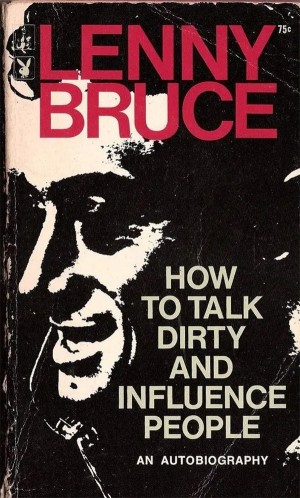
Paul edited Bruce’s autobiography How to Talk Dirty and Influence People, published by Playboy Press in 1965. In 2016, the book was re-published by Da Capo Press in a paperback edition, with a Preface by Lewis Black and Foreword from Howard Reich.
During 2004, I interviewed Krassner.
“Groucho Marx once called me Lenny Bruce’s successor. It’s like you are part of a myth and handed some kind of torch,” mused Krassner. “The audience are your peers, not your inferiors. And a lot of performers treat them like that. When Lenny Bruce would meet people, he wouldn’t do shtick. He would ask questions and learn. And then sometimes that would become part of his act; the dialogue that ensued. Lenny’s exact words were: ‘I am part of everything I indict.’
“He made it a point to try to never get a laugh because of a four-letter word. He’d be doing a character, and for that aptness of character, he would use the language, or he would analyze the language. Many comics today get their laughs with profanity, on the beat,” he continued.
“I was just at the Montreal Comedy Festival. 350 stand-up comics and the janitor had to come up on-stage to sweep the dick jokes off the stage. But there were a few that shone out in the midst of it.
“I learned a great deal from Lenny. When I first started performing, I was billed as Paul Maul, and he told me to use my real name. I learned compassion from him. He would take things from the point of view of the villain, you know, and carry it to the ultimate. He had empathy for all points of view. It didn’t necessarily get laughs, but he became a communicator, not just a comedian,” Krassner reinforced.
“When I first met him in 1959, Lenny would come out with a newspaper headline, or he’d play ‘Spanish Harlem’ from a record when he came on stage. He would do ‘show and tell’ things like that. Later on, it happened to be the legal briefs that he would be doing. I started with an envelope of press clippings, and I would just go off on that. And after a while, I dropped the clippings.
“Phil Ochs and I became friends. He’s one of those people who are still with me. On occasion, I’ll hear Lenny say, ‘Don’t tell that joke, it’s a cheap shot.’ Or I’ll go to an afternoon movie alone, and Ochs will have a reaction to the film.”

Phil Spector is the co-writer with Jerry Leiber of “Spanish Harlem.” A favorite song of Senator Robert F. Kennedy, who sang it live with footballer Roosevelt Grier on guitar during his 1968 Democratic Presidential campaign. Phil once played a game of pool with Kennedy at The Factory Club.
In the mid-seventies, Spector released an LP on his Warner/Spector label, The Law, Language and Lenny Bruce. It was recorded the night before Bruce’s death.
Jerry Wexler, the former Atlantic Records executive and record producer, supplied the illuminating liner notes to The Law, The Language and Lenny Bruce.
“Dear Phil: Thank you for the test pressing on Lenny. I think it is fantastic.
“Many of the bits in this LP surpass in brilliance, insight, and compassion anything I’ve heard of Lenny’s. I had come to the point where his judicial musings were beginning to put me off, and I was beginning to regard his obsession with his trial (and trials) as a bore. I have a new insight. Lenny really achieves new dimensions as a prophet when he addresses himself to the nature of the law, the judge and policeman in the same sense as the Old Testament prophets did when they attacked kings and commoners alike, exposing the unending cop-outs and rationalizations with which people protect their paltry possessions and nurse their hard-won neuroses and precious foibles. Those in power are better able to perpetuate their grip on their baggage, both material and psychic, than those they oppress; but both the haves and the have-nots are uptight in this regard.
“When Lenny is really popping and cooking, as he is in this LP, I get so turned on that I get a euphoric kick. It is a case of terrific rapport and shared viewpoint, and an electric-like phenomenon of awareness takes place, perhaps what James Joyce refers to as ‘epiphany’ in Portrait of the Artist. Lenny induced this in me many times in clubs, but I don’t remember it happening listening to his records until this time. Again, I thank you for the record.”
Last decade, Wexler and I talked about the liner notes I was preparing on the first-ever CD release on Water Records of Allen Ginsberg’s 1965 Kaddish album. It’s a live recording from a radio station on the Brandeis University campus in Waltham, Massachusetts. Wexler initially issued it as an LP on Atlantic Records.
I asked Jerry to comment on Phil Spector.
“I’m still very fond of him,” stressed Wexler. “All of Phil’s aggressions and talents were apparent to us at Atlantic when he was a kid. He was brash, cocky, and talented. A pop genius like Jerry Leiber.
“I respect Phil. He could do it all. The song and the recording existed in his brain. Phil’s records were made in his head before he even entered the recording studio. When Phil went into the studio, it came out of him, like Minerva coming out of Jupiter’s head. Every instrument had its role to play, and it was all prefigured. The singer was just one tile in this intaglio,” underlined Wexler.
“Phil was born on Christmas Day in 1940,” posed writer and novelist Daniel Weizmann, who authored A History of Rock. “But I see him as the first truly post-Holocaust American Jew. He refused to grovel and play the Borscht Belt guy, the entertainment guy. And yet he had one foot in that old world grandiosity. His music was for the new utopian free-spirited teenagers, but it also contained the secret mania of having grown up with the shadow of genocide and the bomb. He meant business.
“In a way, he is the link between Lenny Bruce and Bob Dylan. Once Phil planted the seed, the sixties just had to happen.”
In a 1976 interview I did with Fairfax High graduate Spector for Melody Maker inside his Beverly Hills mansion, we discussed Lenny Bruce. Spector touted Malcolm X, Lenny Bruce, Paul Robeson and Muhammad Ali as his heroes.
“My graduating theme was ‘Daring to Be Different,’ Phil announced. “The moment I dared to, they called me different. I always thought I knew what the kids wanted to hear. They were frustrated, uptight. I would say no different from me when I was in school. I had a rebellious attitude. I was for the underdog. I was concerned that they were as misunderstood as I was.
“Lenny Bruce is a star, but they won’t bring him back, which they did with Chaplain. Lenny was my brother,” he emphasized. “He was one of the greatest people who ever lived. One of the greatest philosophers who ever lived. I was fortunate enough to know great people to be inspired to do things.
“I refer back to Lenny a lot. I believe he played a great part in my life. You know, he was misjudged, mistreated, and misunderstood. To say he died for Deep Throat is bull. Lenny was murdered!”
Drummer Hal Blaine was booked on Spector’s production of Ike & Tina Turner’s “River Deep, Mountain High” at Gold Star recording studio. In the mid-fifties, as Harold Simon Belsky, he did gigs with Bruce in San Bernardino at a club called The Magic Carpet.
I was very fortunate to know and interview for a few of my books, writer and deejay Dave Diamond, a powerful rock ‘n’ roll voice on the Southern California airwaves during 1965-1967. Initially on AM radio stations KHJ, KBLA and KFWB, Diamond in 1965 had a KHJ 6:00 pm slot, following the legendary Real Don Steele that helped launch the game-changing Boss Radio format.
During a 2004 email exchange, Dave detailed a 1966 escapade with travel companion Spector when Phil took him to see Lenny Bruce in San Francisco.
“One Sunday Phil calls and asks if I wanna go see Lenny Bruce, the midnight show at the Basin Street West in San Francisco. It was about 8:00pm, and he said we could make the midnight show if we caught a United flight at 9:00pm Which we did.
“We made the Lenny Bruce show after having a drink with [deejay] Tom Donahue, whom we met in the bar. Lenny, of course, was sliding downhill at that point, and his show consisted of him in jeans, lumberjack boots, and a newspaper, from which he quoted and tried to make political comments with humorous kickers. It really wasn’t working. The place was fairly empty.
“Phil and I had cocktails and coffee, and Phil and Lenny talked business for a few minutes. One could see Phil did love Lenny and wanted to help him. We were back on the plane for L.A. around 9:00 am the next morning.”
“Once I left for San Francisco, we drifted apart. I did send him a glowing letter about ‘River Deep, Mountain High,’ and he sent me a gracious reply.
“I later went back to work at RKO in San Francisco, where they gave me a little more slack, and I tightened up and held # 1 rating at KFRC radio for four years.
“I can truthfully say that in all my dealings with Phil he was a friend, a peaceful man, a gentleman. He was meek, tender, and an incredible talent.”

“I readily confess to spending – much opposed to wasting – beyond my fair share of time beneath headphones with Monty Python and even more word-wisely the Firesign Theatre when I should have been studying through high school,” offers Canadian “eh”-student Gary Pig Gold.
“Yet it was in the throes of Zappa collecting back then that I first came across a 1969 Bizarre/Reprise release called The Berkeley Concert, a posthumously released recording from December of ’65 by someone I’d heard of – via his obvious disciple George Carlin – but up until that day had never actually heard.
“Then, a good decade-and-a-half later at the dawn of what we may now call the Video Age, I came into possession of (via some mysterious far-off P.O. box) a VHS tape called The Lenny Bruce Performance Film …which came complete with an ‘opening featurette’ animation of the man’s classic ‘Thank You Mask Man’ to boot. Again, I was – quite eagerly and happily so – delivered another bout of mental whiplash care of this absolute master of the meticulous.
“Of course, in every single year since and counting, I have made it a point to avail myself of each and every interview, biography (Albert Goldman’s is highly recommended), newspaper clipping, magazine profile, audio and/or video recording and sometimes even re-creation (yes, including Dustin’s) that I can of the man and his mindful art, as I like to call it. I consider this all more than necessary food for thought, from a giant who was even more prescient, as it turns out, than he was delightfully ‘perverse.’ Long may he swear.”
There is another memorable encounter with Lenny Bruce, courtesy of record producer and artist manager Denny Bruce. In 1965, Bruce worked as a drummer with Frank Zappa, and at the time had an encounter one very late evening with Lenny Bruce, Zappa and Spector at Canter’s Delicatessen.
Denny emailed me in August 2016.
“Frank Zappa had the feeling that perhaps Phil Spector could appreciate what the Mothers of Invention stood for, on all levels. The band had been turned down already by most of the L.A. labels, all of whom were ‘majors.’ We had Elliot Ingber on lead guitar. Phil knew him from high school and earlier played with him.
“Frank saw Phil as an indie label guy, who was doing well with his own label, making hits. And, looking at his track record, not to mention the Rolling Stones, he would be open to getting into business with us.
“I think it was Herb Cohen who talked to Phil about meeting with Frank and seeing what happens. A meeting was set up for 2:30 a.m. at Canter’s Deli, on Fairfax. Frank wanted to me to come and keep him company. We are a little early, have some coffee, and now it is 3:00 am. Frank said, ‘I wasn’t expecting him to be on time!’ Maybe at 3:20 a.m. we see Phil walking in, and he has Lenny Bruce with him.
“We had heard that Phil had been helping Lenny out, financially, as by now he was broke, and nobody would hire him. Lenny looked pale and tired. He had a big blue ‘law book’ and a legal pad. So, it’s the four of us in a booth for four, under the bright lights of Canter’s. A waitress who looks like she has worked there all of her life asks if we need menus. ‘No, we will order.’
“Lenny goes straight into opening his law book and says, ‘Dig this silly shit!’ Now he is reading about another case that is somewhat similar to what he is going through. Fifteen minutes later he is still reading aloud, and writing things down.
“Frank finally says, ‘Hello, I am Frank Zappa. It is a pleasure both of you are here.’
“Lenny looks at me and says, ‘And, who are you?’
“I said, ‘Denny Bruce.’ He laughs really loud. He says, ‘C’mon, what is your real name?’
“I responded, ‘Dennis Bruce.’ He loves it, and tells the story of how he had to change his name for ‘showbiz’ reasons, from Leonard Schneider, and needed something ‘Goyim,’ so he could get dates in the Midwest. He picked Bruce out of the sky.
“Needless to say, it was hard to ask him to be quiet, as this is a business meeting. But on the other hand, it felt like Phil wasn’t ready to say, ‘What kind of deal are you guys looking for?’ And it just kind of ended without any business mention at all.
“I walk out with Frank to his Chevy station wagon, and he looks at me and says ‘Is Denny Bruce your real name?’ I said ‘Yes!’
“Zappa shrugged, ‘I was under the impression you changed your name as a tribute to Lenny Bruce!’”
Zappa’s manager Herb Cohen, with Frank, formed Straight Records and released Lenny Bruce The Berkeley Concert and Lord Buckley’s A Most Immaculately Hip Aristocrat, a compilation of unissued tapes.

Buckley had an avid cult following of jazz and rock musicians, hippies, beatniks, and FM radio deejays. In 1977, George Harrison’s hit single, “Crackerbox Palace,” was inspired by Buckley’s home in the Hollywood Hills. Buckley was heard on the ABC-TV nationally syndicated Beany and Cecil animated television series created by Bob Clampett when he was the voice of “Go Man Van Gough.”
“What I love about Zappa is the way he connects to the pre-Beatle world of American bohemianism,” noticed essayist Daniel Weizmann.
“Even long after he became the reluctant king of hippiedom, Zappa always struck me as a beatnik at heart, with that same Mad [magazine] trickster spirit of Lenny Bruce, Russ Meyer, early Bukowski, Venice cats like Lawrence Lipton and Stuart Z. Perkoff, and the whole crosshatch of subcultures that were just under the surface in Cali ’59 to ’63—bikers, surfers, poets, bongo-heads all pulling for exotica, for erotica, for something else—‘the left behinds of the Great So-ci-e-ty!’ (Cue the kazoos!) Case in point: In early ’65, Zappa got busted by a vice squad undercover officer for agreeing to produce a ‘sexually suggestive reel-to-reel’ for a stag party.”
In late 2000, Columbia Records released the soundtrack album to the Paramount Pictures film Wonder Boys, featuring singer/songwriters including John Lennon, Bob Dylan, Van Morrison, Neil Young, Tim Hardin, Tom Rush and Leonard Cohen.
t’s directed by Academy Award-winner Curtis Hanson (L.A. Confidential), stars Michael Douglas, Toby Maguire, Frances McDormand, Katie Holmes, Rip Torn, Richard Thomas and Robert Downey, Jr.
The soundtrack and film incorporate a new recording by Dylan, “Things Have Changed,” which won an Oscar for Best Original Song at the 2001 Academy Awards Show.
I interviewed Hanson in 2000 for HITS magazine. In the mid-sixties, he attended college at Cal State Los Angeles and had a stint as a movie reviewer/entertainment writer for the school newspaper.
In 1966, former San Fernando Valley boys, Curtis and his pal, budding screenwriter Michael Jenning, who later wrote Next of Kin and Spot Marks the X, schlepped to Hollywood and witnessed Lenny Bruce at the Music Box Theater.
“Lenny was very funny on stage. Curtis introduced me to Bruce’s work from his red vinyl albums on Fantasy Records,” Jenning remarked in 2026.
“When I was 18,” Hanson reflected, “I went to Cal State L.A., over on the other side of town, pretended to be a journalism major, became the movie critic for the paper, and turned that into entertainment editor. They gave me a page a week.
“So, then I was at The Ash Grove, The Troubadour, Shelley’s Manne-Hole, The Light House, and McCabe’s Guitar Shop. I was seeing people like Tim Hardin and Tom Rush. And seeing them free (laughs).
“Tim Hardin I’ve been a fan of since day one. The album Tim Hardin 2 was an LP that I wore out a couple of copies back when it was new.”
Hardin’s fourth album, Tim Hardin 3: Live in Concert, released in 1968, includes the song “Lenny’s Tune” about his friend Bruce.
The Official Website of Lenny Bruce
https://lennybruce.org
© 2026 Harvey Kubernik
Harvey Kubernik is the author of 20 books, including 2009’s Canyon Of Dreams: The Magic And The Music Of Laurel Canyon, 2014’s Turn Up The Radio! Rock, Pop and Roll In Los Angeles 1956-1972, 2015′s Every Body Knows: Leonard Cohen, 2016′s Heart of Gold Neil Young and 2017′s 1967: A Complete Rock Music History of the Summer of Love.
Sterling/Barnes and Noble in 2018 published Harvey and Kenneth Kubernik’s The Story Of The Band: From Big Pink To The Last Waltz. In 2021 they wrote Jimi Hendrix: Voodoo Child for Sterling/Barnes and Noble.
Otherworld Cottage Industries in 2020 published Harvey’s Docs That Rock, Music That Matters. His Screen Gems: (Pop Music Documentaries and Rock ‘n’ Roll TV Scenes) was published in 2026 by BearManor Media. Kubernik is currently working as the Creative Director and author of a book on the Beatles for a UK publisher scheduled for 2027 publication.
Harvey spoke at the special hearings in 2006 initiated by the Library of Congress held in Hollywood, California, discussing archiving practices and audiotape preservation.
In 2017, he appeared at the Rock & Roll Hall of Fame in Cleveland, Ohio, in its heralded Distinguished Speakers Series, and as a panelist where he discussed the forty-fifth anniversary of The Last Waltz at the Grammy Museum in Los Angeles in 2023.
During 2025, Kubernik was interviewed in the Siobhan Logue-written and -directed documentary The Sound of Protest, airing on the Apple TVOD TV broadcasting service. The film also features Smokey Robinson, Hozier, Skin (Skunk Anansie), Two-Tone’s Jerry Dammers, Angélique Kidjo, Holly Johnson, David McAlmont, Rhiannon Giddens, and more.
Harvey was an interview subject along with Iggy Pop, the Beach Boys’ Bruce Johnston, Love’s Johnny Echols, the Bangles’ Susanna Hoffs, Victoria, Debbi Peterson, and founding members of the Seeds for director/producer Neil Norman’s documentary The Seeds: Pushin’ Too Hard. In summer 2026, the GNP Crescendo company will release it on DVD/Blu-ray).